
Your RAV4 Hybrid or Plug-In Hybrid is engineered differently than a conventional SUV. Making smart choices about your tires can protect your investment, extend your range, and keep you safe year-round.
Know Your Factory Tire Size
The RAV4 lineup uses different tire sizes depending on model, year and trim level. Always confirm your exact size using the sticker on your driver's door jamb before purchasing replacements or a winter set.
Why Hybrid and PHEV Tires Are Different
Your RAV4 Hybrid or Plug-In Hybrid places unique demands on its tires that a regular gas-powered RAV4 does not. Understanding these differences will help you choose the right replacement tires and maintain them properly.
Extra Weight
The battery packs in hybrid and plug-in hybrid vehicles add extra weight compared to conventional vehicles, which increases the load placed on each tire. This makes it critical to choose tires with an adequate load rating — never go below the load index specified on your door jamb sticker.
Instant Torque
Electric motors deliver power instantly, which accelerates tire wear faster than a conventional combustion engine alone. This means your RAV4 Hybrid's tires may wear more quickly than you might expect, particularly on the front axle.
A Quieter Cabin — For Better and Worse
Because hybrid and plug-in hybrid vehicles run more quietly, road and tire noise becomes far more noticeable. Opting for tires designed with low noise profiles makes a meaningful difference to the driving experience.
Rolling Resistance Matters for Range
Rolling resistance is essentially the force that opposes your tires' motion as they roll on the road. The lower the rolling resistance, the less power your battery needs to supply to move the vehicle forward — meaning you can travel farther on a single charge. For RAV4 Plug-In Hybrid owners especially, choosing low rolling resistance tires can meaningfully extend your EV-only driving range.
Choosing the Right Tires
The right tires for your Plug-In Hybrid come down to your driving habits, your priorities, and the climate you live in. If you do a lot of long highway driving, look closely at durability and tread life. If you want a quiet, comfortable ride, look for tires engineered with ultra-quiet tread designs that still deliver solid performance and wear.
In Canada, with our extreme seasonal swings, most RAV4 Hybrid and Plug-In Hybrid owners benefit from running two dedicated sets — summer/all-season tires and a dedicated winter set — rather than relying on all-season tires alone through the year.
Winter Tires: Essential for Many Canadian Hybrid Owners
Running a dedicated set of winter tires is one of the smartest investments a Canadian RAV4 Hybrid or Plug-In Hybrid owner can make. The combination of extra vehicle weight, instant electric torque, and Canada's icy and snow-packed roads makes this especially important.
Winter tires are built with softer compounds that remain flexible in colder temperatures, improving traction on the road. The tread blocks contain more sipes — cutaways that increase grip by giving the tire more edges to grab the road and clear rain and snow.
Winter Tire Timing — Quebec & Beyond
If you drive in Quebec, winter tires are legally required between December 1 and March 15. In B.C., winter tires are route specific. In other provinces and territories, they are strongly recommended and may qualify for insurance discounts.
Rim Considerations for Winter Sets
Many RAV4 Hybrid and Plug-In Hybrid owners choose a dedicated set of steel rims for their winter tires. Steel wheels are more economical, highly durable in the face of road salt and potholes, and protect your premium alloy wheels from winter damage.
Tire Maintenance Tips for Hybrid and Plug-In Hybrid Owners
These habits are important for any vehicle, but carry extra weight for hybrid and PHEV owners because tire condition directly impacts your fuel efficiency and electric range.
Check Pressure Monthly
Tires lose about 1.5 psi of air every month. Over time, under-inflated tires can result in hazardous handling and tires overheating at higher speeds — and it affects the range of your PHEV. Always confirm against the tire pressure information label located on the driver's door jamb.
Rotate Regularly
Tire rotation is especially important on PHEVs, many of which rely on regenerative braking that puts greater stress on specific axles. Even on all-wheel drive vehicles, rotating tires every 8,000 to 10,000 kilometres is recommended.
Monitor Tread Wear More Frequently
Because of the extra weight and torque characteristic of hybrid drivetrains, if you drive an EV or hybrid, monitor tire wear more often than you would with a conventional vehicle. Catching uneven wear early can prevent premature replacement and maintain your vehicle's handling.
Pre-Condition in Winter for Better Range
Simple steps like pre-heating the vehicle cabin while it is still plugged in and driving in eco-mode can help offset the range reduction that comes with winter driving and winter tires.
The Spare Tire Question
Depending on your specific RAV4 Hybrid trim, your vehicle may come with a compact temporary spare.
Check your owner's manual or door jamb to confirm what your specific model includes. Modifications might be possible to fit a full-sized spare, but some report that the storage space requires modification. Full-sized spare tires may be too and do not allow the cover to lie flat. Check with your dealer or tire specialist.
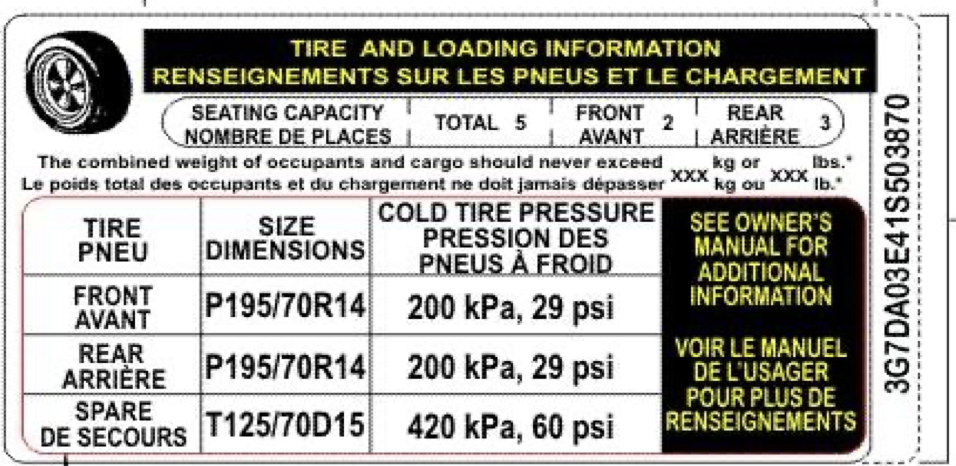
The vehicle placard (tire and loading information) provides several key pieces of information:
Seating Capacity: The total number of occupants the vehicle can safely carry. Maximum Load: The combined weight of occupants and cargo that should never be exceeded.
Tire Specifications: The original equipment tire size.
Cold Tire Pressure: The recommended inflation pressure for both front and rear tires, usually listed in both kilopascals (kPa) and pounds per square inch (psi).
What do the letters and numbers mean?
In Canada, tire sidewalls follow an international standard that provides a snapshot of the tire's dimensions and capabilities.
Based on the label above for the front tire: P195/70R14, this breaks down as follows:
| P | Service Type | Indicates a "Passenger" vehicle tire. |
| 185 | Width | The width of the tire from sidewall to sidewall in millimetres. |
| 70 | Aspect Ratio | The height of the sidewall expressed as a percentage of the with; in this case, the height is 70% of 185mm. |
| R | Construction | This is radial, which is the standard internal design for almost all modern tires. |
| 14 | Wheel Diameter | The size of the wheel (rim) the tire is designed to fit, measured in inches. |
Tires also have a load rating, which is how much much weight the tire can handle if inflated properly. This corresponds to a load index chart.
The last letter of the tire code is the tire’s speed rating, which is the max speed the tires are rated for in ideal conditions.
Important Canadian Indicators
Beyond the size, you should also look for specific symbols relevant to our climate:
The Three-Peak Mountain Snowflake (3PMSF): A snowflake inside a mountain symbol indicates the tire has met specific performance criteria for severe snow conditions.
M+S: Stands for Mud and Snow, often found on "all-season" tires, though these do not offer the same grip as dedicated winter tires in deep cold.
DOT Code: A string of letters and numbers ending in four digits (e.g., 1225) on the side of your tire, tells you when the tire was made. The first two digits are the week and the last two are the year, which is vital for ensuring your tires aren't too old to be safe.
It is important to check this label specifically for the vehicle's unique configuration, as recommended pressures can vary based on trim level and wheel size.
Tire Wear
Modern tires have built-in tread wear indicators — small raised rubber bars moulded into the tread grooves that become flush with the surface when the tire has reached the legal minimum tread depth of 1.6mm (2/32"). However, for Canadian driving conditions, the practical replacement threshold is higher than the legal minimum — 3.2mm (4/32") for all-season tires and 4.8mm (6/32") for dedicated winter tires, as grip in snow and wet conditions degrades significantly below these depths. For RAV4 owners planning to keep their vehicle long-term, remember that tread depth alone does not tell the whole story — tire rubber degrades with age regardless of wear, and replacement is generally recommended at six years.
Disclaimer: R4Canada is an independent enthusiast site documenting a personal ownership journey. Content is created through a combination of personal experience, online research, and the assistance of AI tools.
All information is provided for informational and entertainment purposes and is not a substitute for professional mechanical advice. We are not affiliated with Toyota Canada. Automotive work involves inherent risks; always consult your official Toyota Owner’s Manual and a licensed technician before attempting any maintenance. Use of this site constitutes agreement to our Legal Notice and Terms of Use.